Introduction: At the Center of Everything, a Heart Beats
Sometimes, the greatest mysteries of life hide within the smallest things.
In a grain of sand lies a universe — and in an atom, a sun.
Today, I will open for you the door to that small but immensely powerful world called the nucleus.
The “nucleus” is the heart of the atom. It’s invisible, yet holds enough energy to light up — or destroy — an entire city.
That’s why scientists treat it with both awe and responsibility.
What Does the Nucleus Do?
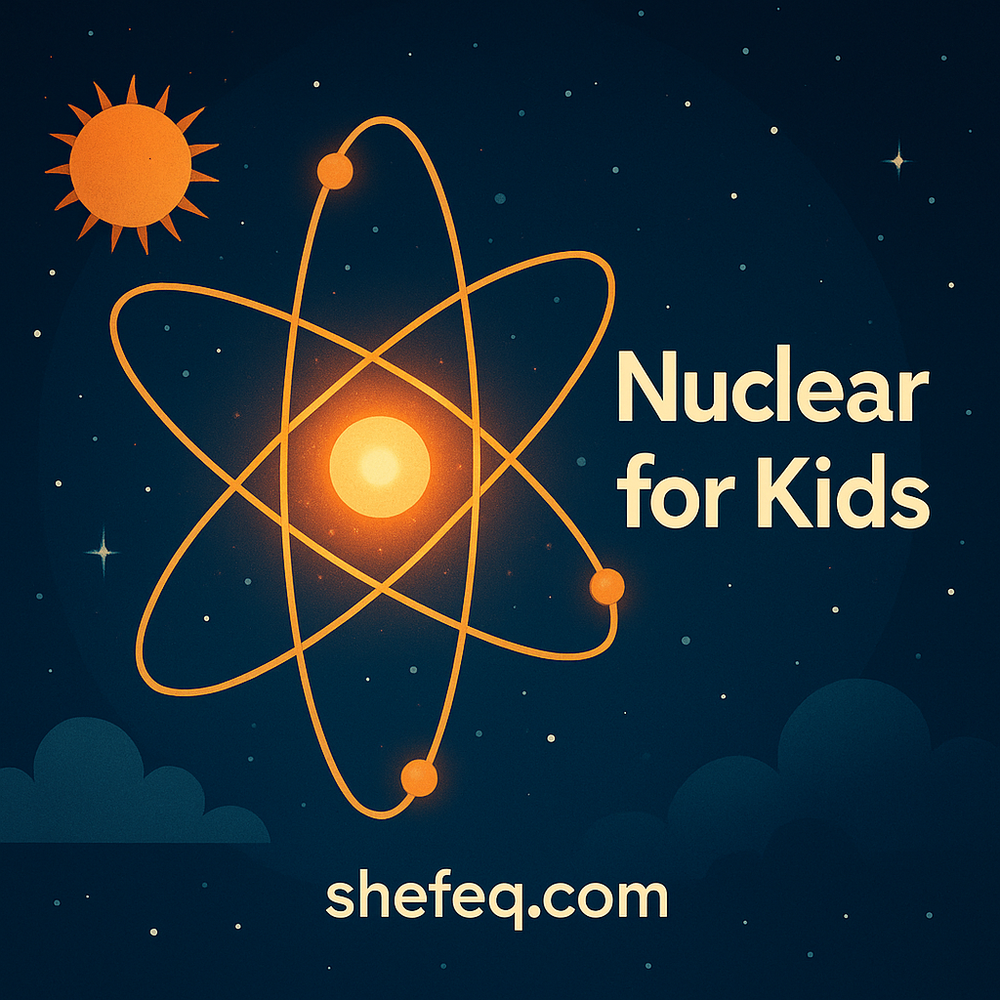
An atom is like a tiny family: the nucleus sits at the center, surrounded by orbiting electrons.
Inside the nucleus are protons and neutrons — carriers of the oldest force in existence.
This power awakens in two ways:
-
When it splits (fission) — energy is released, heat is born.
-
When it joins (fusion) — stars are born, the Sun burns, the universe glows.
So when you look at the Sun, you’re really looking at nuclear energy in action.
Nuclear Energy – The Invisible Side of Light
Science has turned this invisible force into a gift for humanity.
Nuclear power plants convert it into heat and electricity, lighting our homes.
Today, about 14% of the world’s electricity comes from nuclear energy.
The United States, France, and Japan lead in this field — they use the atom’s strength to create light.
But the greater the power, the greater the responsibility.
Disasters like Chernobyl, Fukushima, and Three Mile Island remind us how carefully this force must be controlled.
Nature’s Nuclear Lesson
In truth, nuclear energy isn’t a human invention — it’s a law of nature.
Every second, the Sun fuses hydrogen into helium, releasing immense energy.
Our warmth, our daylight, even our life — all come from this process.
Every breath we take carries the quiet rhythm of nuclear reaction.
Humanity and the Atom – A Dialogue of Knowledge and Conscience
Human intelligence has reached deep enough to “hear” inside the atom itself.
But such knowledge brings both creation and destruction.
Throughout history, nuclear energy has served not only electricity but also weapons.
In 1945, Hiroshima and Nagasaki witnessed the painful side of this power — hundreds of thousands of lives lost.
That’s why scientists often say:
“Nuclear energy is neither good nor evil — it is simply power.
How we use it depends on the conscience of humanity.”
A Woman Who Became the Symbol of Science – Marie Curie
One of the pioneers in this field was Marie Curie.
Her groundbreaking research on radioactivity changed the course of science.
But long exposure to radiation eventually took her life.
Her story remains a timeless lesson:
Knowledge is light — but get too close, and you may be burned.
Conclusion: The Poetic Rhythm Inside the Atom
The atom’s nucleus is the tiniest secret of the universe, yet it teaches us the greatest truth:
Every great power begins from a small center.
That center symbolizes energy, life, and responsibility.
Perhaps humanity itself is a kind of “nucleus” —
a small universe filled with energy, emotion, and creativity.
Science helps us understand this universe within,
but only compassion and beauty can help us guide it.
Now you know: the atom may be small,
but within it lies a sun’s worth of life.
And every time the light turns on, it whispers:
“Science is a miracle — but only conscience can guide its power.”