
Introduction: A Universe Opening in Silence
Dua... Raised hands in a quiet corner, the trembling whisper of the heart, a gaze full of hope toward the Unseen. For some, it is a daily ritual; for others, the most delicate, emotional moment of life. Dua is both an inner cry and a bridge to the heavens.
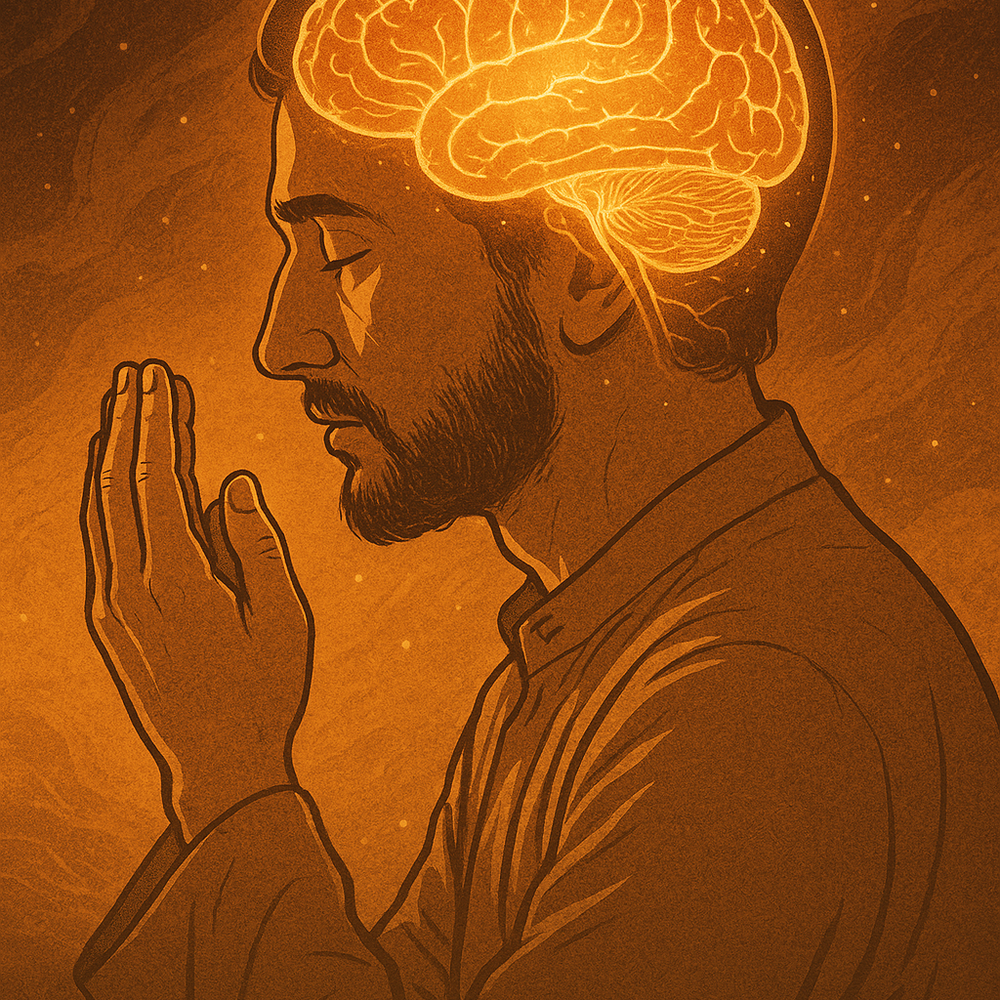
But what really happens in our brain, soul, and body when we pray?
Is dua simply a religious act of devotion, or is it a psycho-physiological state that touches the deepest levels of our being?
In this article, we’ll explore dua not only as a religious concept, but through neurological, psychological, and philosophical dimensions — analyzing the changes that occur during prayer from the perspectives of both science and faith.
1. What is Dua? – Not Just Words, but a State of Being
In Islam, dua is the act of turning to Allah — a private conversation, a sincere expression of the soul’s desires. The Qur’an says:
"Call upon Me, and I will respond to you." (Ghafir 40:60)
Dua is not merely a form of asking — it is trust, refuge, purification, and spiritual revival.
Imam al-Ghazali described it as:
"Dua is closeness to Allah. Whoever prays is embraced by His mercy."
"Dua is a supplication transformed into the voice of the heart."
In essence, dua is not about speaking — it is about creating a spiritual state.
2. What Happens in the Brain? – The Neurophysiology of Prayer
Scientific studies show that prayer and meditation-like practices cause notable changes in the brain.
a) Prefrontal Cortex Activation
This area is responsible for decision-making, focus, and planning. During prayer, activity in this region increases, enhancing internal awareness and concentration.
b) Calming of the Amygdala
The amygdala is the emotional center related to fear and anxiety. During dua, it calms down, creating emotional balance and peace.
c) Increase in Serotonin and Dopamine
These chemicals are linked to happiness and well-being. Prayer boosts their levels, acting as a natural antidepressant.
d) Activation of the “God Spot”
Neurologist Andrew Newberg notes that during intense prayer or meditation, brain regions associated with mystical and spiritual experience light up — increasing the sense of closeness to the Divine.
3. The Language of the Heart: The Psychology of Dua
When a person makes dua, they are speaking not only to God — but also to themselves. In psychology, this is called inward monologue. To be honest with oneself — without fear or shame — is healing.
Dua After Trauma
Many people begin to pray after losses or crises. Dua often becomes a key part of emotional recovery.
Dua vs. Despair
Hope is a life-sustaining force. Dua is a structured form of hope.
Ibn Qayyim said:
"Dua is the door that despair cannot open. Whoever knocks — it will be opened for them."
4. Not Energy, But Connection – The Metaphysical Side of Dua
Some describe dua as spiritual “energy release,” but in Islam, dua is a direct connection.
You speak — and Allah hears, sees, and responds.
The answer may not come as you expect — but it will come at the right time, in the best way.
The Qur’an contains many examples: Prophet Zakariyya, Ibrahim, Yusuf...
5. Dua and Time – The Irreversible and the Transformable
In Islam, dua does not change the past — but it illuminates the future.
The Prophet Muhammad (peace be upon him) said:
"Dua can change what was destined to occur in the future."
Sometimes, dua is a test of time. Through it, a person is tested in patience, faith, and trust in Allah — a journey of deep spiritual growth.
6. Collective Energy: Praying Together
There is a difference between personal prayer and communal dua.
Studies show that praying in groups enhances emotional strength and protection.
Think of Ramadan nights, Taraweeh prayers, or collective prayers on Laylat al-Qadr — moments where collective spirituality uplifts the soul.
7. Dua and Silence – The Art of Listening
Dua is not only about speaking. Sometimes, dua is silence itself — a way to listen to Allah.
To hear the soul, to feel the whisper of the heart, to sense the rhythm of the universe.
Ibn Ata’illah al-Iskandari said:
"If you made dua and the answer seems delayed, do not despair. The problem is not that you are not answered — the problem is when you stop asking."
8. Children and Dua – The Voice of a Pure Soul
Children’s prayers are pure, innocent, and unfiltered.
They are not about demanding — but about believing.
When a child makes dua, the brain’s trust center is activated — the child forms a sense that “Someone hears me”, which contributes to self-confidence later in life.
9. The Body’s Response to Dua
Prayer is not only a mental or spiritual activity — the body also responds:
-
Heart rate slows
-
Muscles relax
-
Breathing becomes calm
-
Digestion improves
This proves that dua is not only spiritual — it is a source of physical peace as well.
Conclusion: Prayers Written into the Memory of the Heart
Dua is not simply something we remember — it is what remembers us.
Conversations with Allah leave permanent imprints on the soul.
We may forget them — but the soul does not.
Our brain changes through dua.
Our soul revives through dua.
Our society elevates through dua.
But dua is not just a request — it is an inner revolution.