
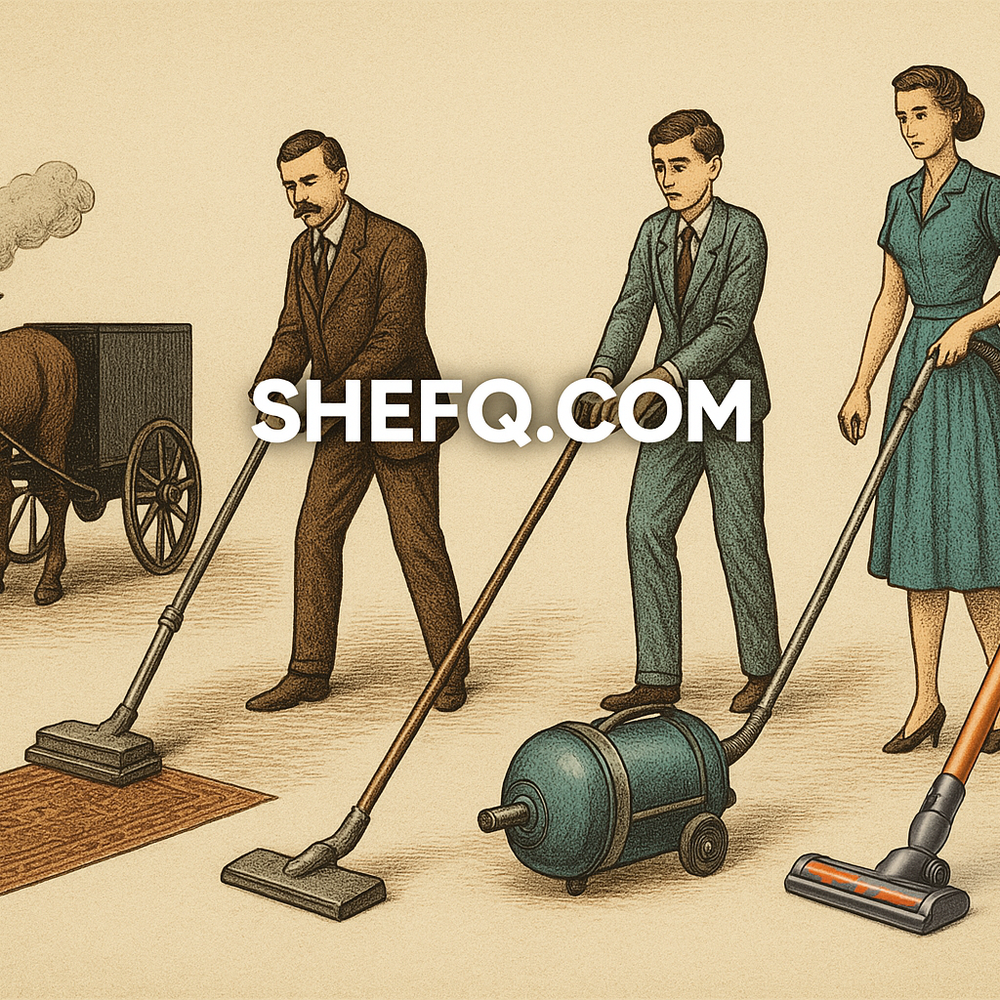
Today, in the “Vacuum Cleaners” section of any home appliance store, it is possible to see countless models. Modern vacuum cleaners—designed for dry and wet cleaning, large and compact, wheeled and portable—are developed using the latest technological innovations to make household cleaning as easy and even enjoyable as possible.
When looking at today’s modern models from brands such as Electrolux or Miele, it is hard to imagine that in the past, cleaning carpets required an entire machine and even the power of two horses.
“Snarling Billy” and the First Attempts at Vacuum Cleaning
In 1901, British engineer Hubert Booth introduced the first vacuum cleaning machine powered by gasoline, known as “Snarling Billy.” The pump, with a power of five horsepower, was placed at the roadside, while carpets to be cleaned were carried outside into the street.
However, this was not the first attempt to mechanize the process of dust removal.
Early Mechanical Vacuum Cleaner Concepts
As early as 1860, American inventor Daniel Hess received a patent for a mechanical device that used rotating brushes and bellows to create airflow. Interestingly, he used two water chambers to collect dust. This idea later became the foundation for vacuum cleaners with water filtration systems.
Nine years later, Chicago inventor Ives McGaffey introduced a device called “Whirlwind.” Although it resembled modern upright vacuum cleaners, it was manually operated, making it very tiring to use. Attempts to adapt it to an electric motor were unsuccessful, and the project was eventually abandoned.
The Rise and Ban of “Snarling Billy”
“Snarling Billy” attracted great interest in London. The machine was demonstrated at the royal court, and even Ottoman Sultan Abdul Hamid II ordered one for his palace.
However, due to its loud noise, horses—the primary means of transportation for city residents—were easily frightened. As a result, London police banned the use of these vacuum cleaners on city streets. The large size and high cost of the machine also made it impractical for household use.
The Electric Era: The Birth of the Motorized Brush
In 1907, American inventor Murray Spengler created the first compact electric vacuum cleaner out of personal necessity. Suffering from dust allergies, Spengler designed a lightweight device with a long handle and a cloth dust bag.
This invention caught the attention of William Hoover, the manager of the factory where Spengler worked. After acquiring the patent, Hoover transformed his leather factory into a vacuum cleaner manufacturing company. The resulting models weighed around 20 kg, which was significantly lighter than previous machines, although the price was still not affordable for everyone.
The Race for Lighter Weight: Siemens and Electrolux
Alongside Hoover, Siemens engineers were also working on the development of vacuum technology. In 1906, wheeled machines weighing around 150 kg gradually began to be replaced by lighter models.
In Europe, Swedish inventor Axel Wenner-Gren made a major breakthrough by replacing the pump with a fan, significantly reducing the weight of vacuum cleaners. The Lux 1 model weighed only 14 kg and gained great popularity. Later, the Electrolux Model V was introduced and became the prototype for the famous Soviet “Raketa” vacuum cleaner.
After the War: Filtration and Noise Reduction Challenges
After World War II, vacuum cleaner technology began to develop rapidly. One of the main challenges was ensuring that the air expelled from the machine was properly cleaned before being released back into the room.
Manufacturers addressed this issue through:
-
multi-stage filtration,
-
water filters,
-
HEPA systems.
While water-filter vacuum cleaners were heavier, they offered superior air purification. At the same time, reducing noise levels remained a key objective.
The Modern Era and Freedom of Choice
Today, vacuum cleaners are available in a wide variety of forms:
-
upright (stick) vacuum cleaners,
-
classic wheeled models,
-
handheld mini vacuum cleaners,
-
central vacuum systems.
Upright models are lightweight and convenient, wheeled models are better suited for those who find frequent bending difficult, and mini vacuum cleaners offer compact, handbag-sized solutions.
Conclusion
The history of vacuum cleaners is a clear example of how technology transforms everyday life. From massive, noisy machines operating on the streets to today’s smart, quiet, and lightweight models, a long journey has been made. Modern consumers now enjoy the freedom to choose the most suitable vacuum cleaner based on their needs and lifestyle.