
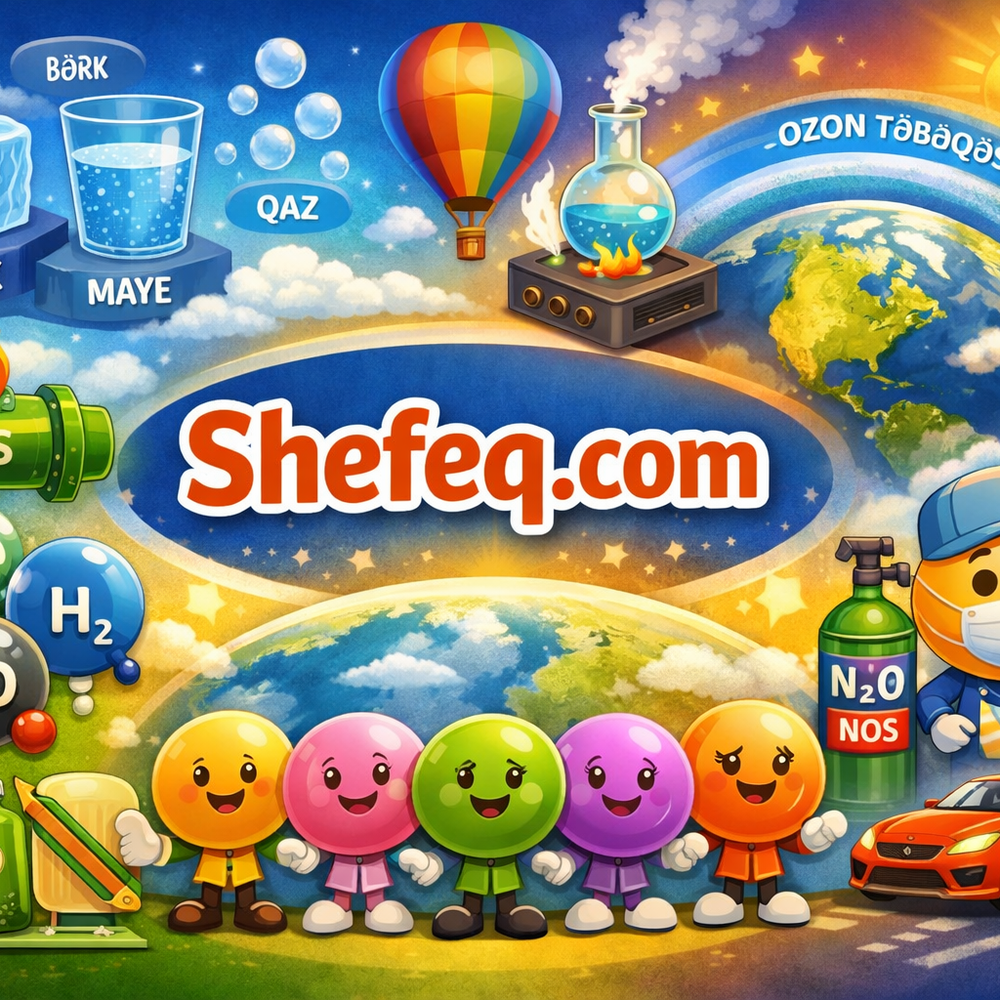
With this fun and educational collection of facts created for children, you will learn what gas is, what natural gas and noble (inert) gases are, what air is made of, what the ozone layer is, and how gases are used in everyday life.
What Is Gas?
Gas is one of the main states of matter.
The other two states are solid and liquid.
Gases cannot be seen with the naked eye, but they:
-
take up space
-
can move
-
create pressure
Types of Gases
-
Pure gases consist of only one atom.
Example: Neon -
Elemental gases are made of two or more identical atoms bonded together.
Example: Hydrogen gas (H₂) -
Compound gases are formed from different kinds of atoms.
Example: Carbon monoxide (CO)
Composition of Air
The air we breathe on Earth is a mixture of different gases:
-
78% nitrogen
-
21% oxygen
-
1% argon
-
very small amounts of other gases
This balance is extremely important for life.
Natural Gas
-
Natural gas is mainly made of methane.
-
It is used as a fuel to produce electricity.
-
In homes, it is widely used for:
-
heating
-
cooking
-
producing hot water
-
Gas Pressure
-
Gas pressure is measured in pascals (Pa).
-
Air inside car tires and gas cylinders are good examples.
Why Do Helium Balloons Float?
-
Helium-filled balloons you see at parties and carnivals float in the air.
-
This happens because helium is lighter than air.
Noble (Inert) Gases
Noble gases are a group of chemical elements that are very stable under normal conditions.
They include:
-
helium
-
neon
-
argon
-
krypton
-
xenon
-
radon
These gases rarely react with other substances.
The Ozone Layer
-
The ozone layer protects the Earth from the Sun’s harmful ultraviolet (UV) radiation.
-
An ozone molecule is made of three oxygen atoms (O₃).
“Laughing Gas”
-
Nitrous oxide (N₂O) is a gas with interesting properties.
-
It is used in hospitals for anesthesia and is therefore called “laughing gas.”
-
It is also used to increase engine power in cars and is known as NOS.
Conclusion
Even though gases are invisible, they:
-
help us breathe
-
produce energy
-
protect the Earth
-
make everyday life possible
Learning about gases is an important step in helping children develop an interest in science.