
Introduction
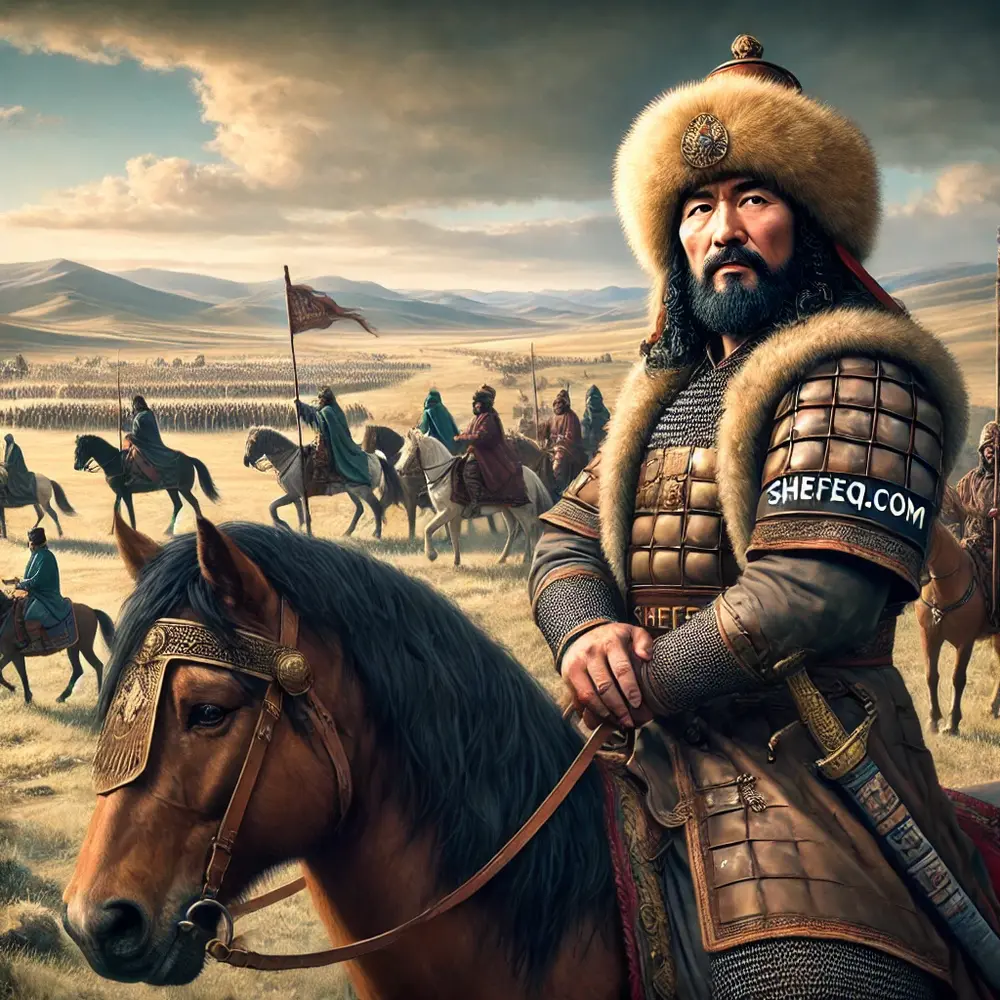
Genghis Khan (born as Temujin) is recognized as one of the most powerful military commanders in history. He united the scattered Mongol tribes and founded one of the largest empires the world has ever seen. With his military strategies, leadership skills, and political brilliance, his name has remained engraved in the memory of generations.
Youth and the Unification of Mongol Tribes
Genghis Khan's real name was Temujin. He was born in 1162 along the banks of the Orkhon River in what is now Mongolia. His father, Yesugei Baatar, was a tribal leader. After his father's death, the family faced serious hardships, but Temujin eventually rose to become a powerful leader.
Temujin skillfully used politics, military tactics, and diplomacy to unify the Mongol tribes. He selected his allies based on merit and loyalty, not blood relations. In 1206, during a grand council (kurultai) held on the banks of the Onon River, he was officially proclaimed Genghis Khan, meaning "Universal Ruler".
Formation and Expansion of the Mongol Empire
Under Genghis Khan’s rule, the unified Mongols quickly built one of the most powerful armies in the world. His military strategies caused psychological, economic, and tactical collapse of his enemies. He organized his army using a decimal system: every ten soldiers had a commander, every hundred a centurion, and every thousand a general.
Foreign Campaigns
-
Campaign Against the Khitans and Jurchens (1209–1215):
Genghis Khan defeated the Khitan forces in Central Asia and took control of Zhongdu (modern-day Beijing), the capital of the Jin dynasty, bringing the region under Mongol control. -
Khwarezmian Empire and Kara-Khitai (1219–1221):
After relations with the Khwarezmian Shahs deteriorated, Genghis Khan launched a massive campaign. He conquered Samarkand, Bukhara, and Khiva, incorporating these cities into the empire. -
Military Expedition Against Russian Principalities (1223):
The Mongols made their first incursion into the Russian lands in 1223, leading to the Battle of the Kalka River, where Russian and Kipchak forces were decisively defeated.
Domestic Administration
While ruling the empire, Genghis Khan established a centralized legal system known as the "Yassa". These laws regulated personal freedoms, trade, and governmental structure.
He actively supported commerce, creating a secure trade environment along the Silk Road. Genghis Khan also promoted religious tolerance, allowing freedom of worship across his vast empire.
Death and Legacy
Genghis Khan died in 1227. After his death, the empire was divided into four main khanates ruled by his sons and descendants. Mongol armies continued expanding into Europe, the Middle East, and India, extending their influence across much of the known world.
Conclusion
Genghis Khan was not only an emperor but also a strategic genius. The Mongol Empire he founded had a profound impact on global political and economic history. Even today, his name is remembered as one of the greatest leaders in history.
I