
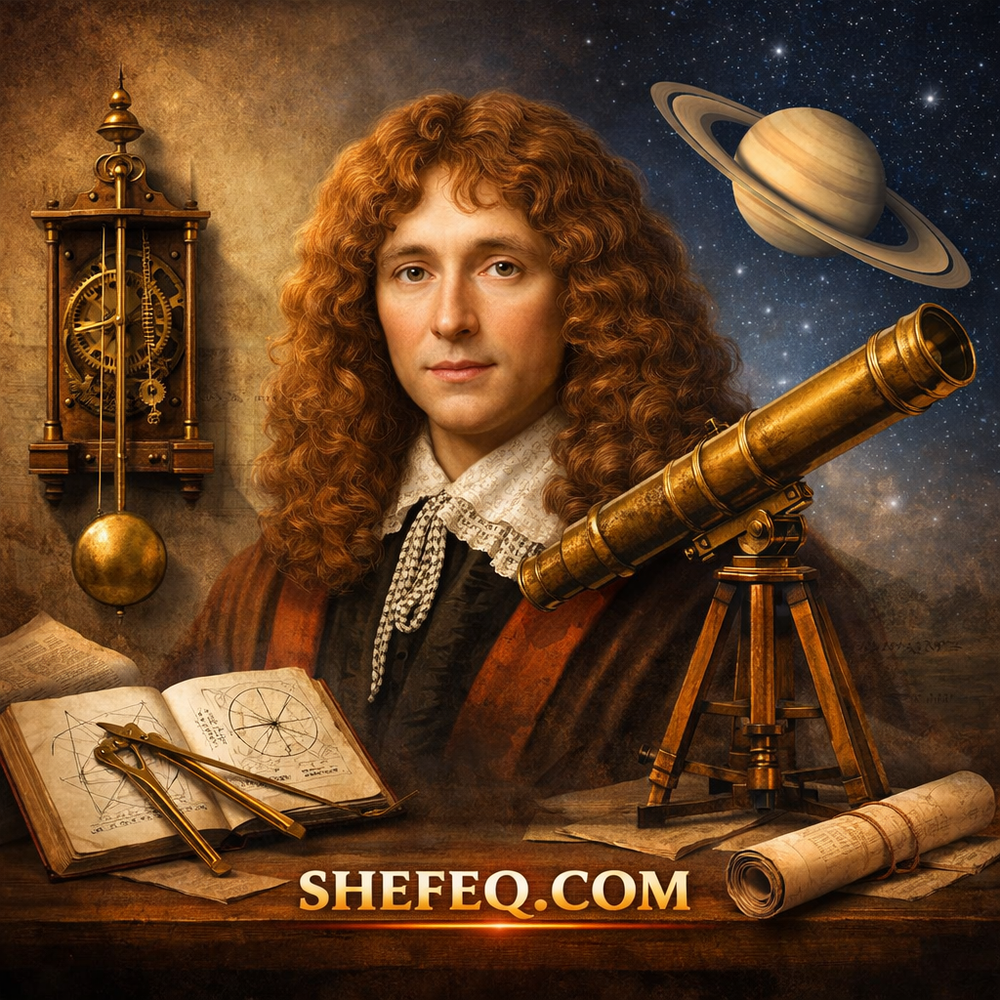
Christiaan Huygens was born on April 14, 1629, in The Hague, Netherlands. He is considered one of the most outstanding scientists of the 17th century and achieved significant scientific accomplishments in the fields of physics, mathematics, astronomy, and optics. Huygens died on July 8, 1695, in his birthplace, The Hague.
Early Life and Family
Christiaan Huygens was born into an educated and influential Dutch family. His father, Constantijn Huygens, was a diplomat, poet, and a man with a strong interest in science. He maintained connections with well-known scholars across Europe and regularly corresponded with the French scientist Marin Mersenne. He was also a close friend of the famous philosopher René Descartes.
Through these connections, Huygens gained access to the most prestigious scientific circles of his time.
Until the age of 16, Christiaan Huygens was educated at home by private tutors. During this period, he studied mathematics, geometry, mechanics, and music. The ideas of René Descartes had a significant influence on his mathematical development.
Education
Between 1645 and 1647, Huygens studied law and mathematics at Leiden University. During this time, he was taught by the famous mathematician Frans van Schooten.
Between 1647 and 1649, he continued his studies at the College of Orange in Breda. Although John Pell was a professor there, he did not have a particularly close academic relationship with Huygens.
Thanks to his father’s connection with Marin Mersenne, a correspondence began between Huygens and Mersenne. Mersenne sent the young scientist various mathematical problems. One of them concerned determining the shape of a string suspended between two points. Although Huygens could not fully solve this problem, he obtained results showing that the curve of the string was close to a parabolic form.
Travels and Early Scientific Works
In 1649, Huygens traveled to Denmark as part of a diplomatic delegation. During this journey, he planned to go to Stockholm to meet René Descartes, but unfavorable weather conditions prevented the meeting. In the following years, he traveled to various cities in Europe, including Rome.
In 1651 and 1654, Huygens published his first scientific works. In these works, he criticized incorrect theories about the quadrature of the circle. In particular, he demonstrated that the methods proposed by Gregory of Saint-Vincent were incorrect.
In 1654, he wrote the work “De Circuli Magnitudine Inventa”, which contained broader investigations in mathematics.
Astronomy and Telescopes
From the mid-1650s onward, Huygens began to focus particularly on optics and telescope technology. He developed new methods for polishing and manufacturing telescope lenses.
Using these lenses, in 1655 Huygens discovered Titan, the largest moon of the planet Saturn.
Shortly afterward, he determined that the unusual structure observed around Saturn was actually a thin ring system. He explained these findings in his work “Systema Saturnium”, published in 1659.
Probability Theory
During a visit to Paris, Huygens became familiar with discussions on probability theory between Blaise Pascal and Pierre Fermat.
His work “De Ratiociniis in Ludo Aleae” is considered one of the first published scientific works on probability theory.
Invention of the Pendulum Clock
Precise time measurement was extremely important for astronomical observations. This problem led Huygens to work on a new mechanical device.
In 1656, he invented the pendulum clock, which significantly increased the accuracy of time measurement, and he obtained a patent for it.
In his book “Horologium Oscillatorium”, published in 1673, Huygens explained the mathematical theory of pendulum motion.
In this work he:
-
formulated the law of centrifugal force
-
solved the problem of the compound pendulum
-
investigated the properties of the cycloid curve
These results later had an important influence on the development of gravitational theory by Robert Hooke, Edmond Halley, and Christopher Wren.
Scientific Societies and the Paris Academy
In 1660, Huygens moved to Paris, where he participated in meetings of several scientific societies. There he met Roberval, Pascal, Desargues, and other prominent mathematicians.
In 1661, Huygens traveled to London, where he became acquainted with the activities of the newly established Royal Society of London. He established close relationships with English scientists and in 1663 he was elected a member of the society.
In 1666, the French finance minister Jean-Baptiste Colbert invited him to join the newly founded French Academy of Sciences. Huygens played an important role in the academy’s scientific activities.
Wave Theory of Light
In 1678, Huygens wrote one of his most famous works, “Traité de la Lumière”.
In this book he proposed a theory explaining the wave nature of light.
According to the Huygens principle, every point on a wavefront acts as a source of secondary waves.
This principle later became fundamental in the development of optics and physics.
Relationship with Newton
In 1689, Huygens visited England and met Isaac Newton, Robert Boyle, and other scientists.
Although Huygens highly appreciated Newton’s scientific talent, he still had certain doubts about the law of universal gravitation. In his opinion, the mechanism by which two bodies attract each other through empty space had not yet been fully explained.
Nevertheless, he acknowledged Newton’s extraordinary scientific abilities.
Final Years
In the final years of his life, Huygens continued his research in optics, mechanics, and astronomy.
In his posthumously published book “Cosmotheoros” (1698), he discussed the possibility of life existing in the universe. This work is considered one of the earliest philosophical discussions related to astrobiology and cosmology.
Scientific Legacy
Christiaan Huygens is considered one of the greatest scientists of the 17th century. He combined the mathematical approach of Galileo Galilei with the philosophical ideas of René Descartes, making an important contribution to the development of classical mechanics.
His main scientific achievements include:
-
the invention of the pendulum clock
-
the development of the wave theory of light
-
the formulation of the law of centrifugal force
-
the development of probability theory
-
the discovery of Titan, a moon of Saturn
-
the explanation of Saturn’s rings
Huygens’s research had a profound impact on the development of physics and mathematics and helped shape the direction of scientific progress in the centuries that followed.