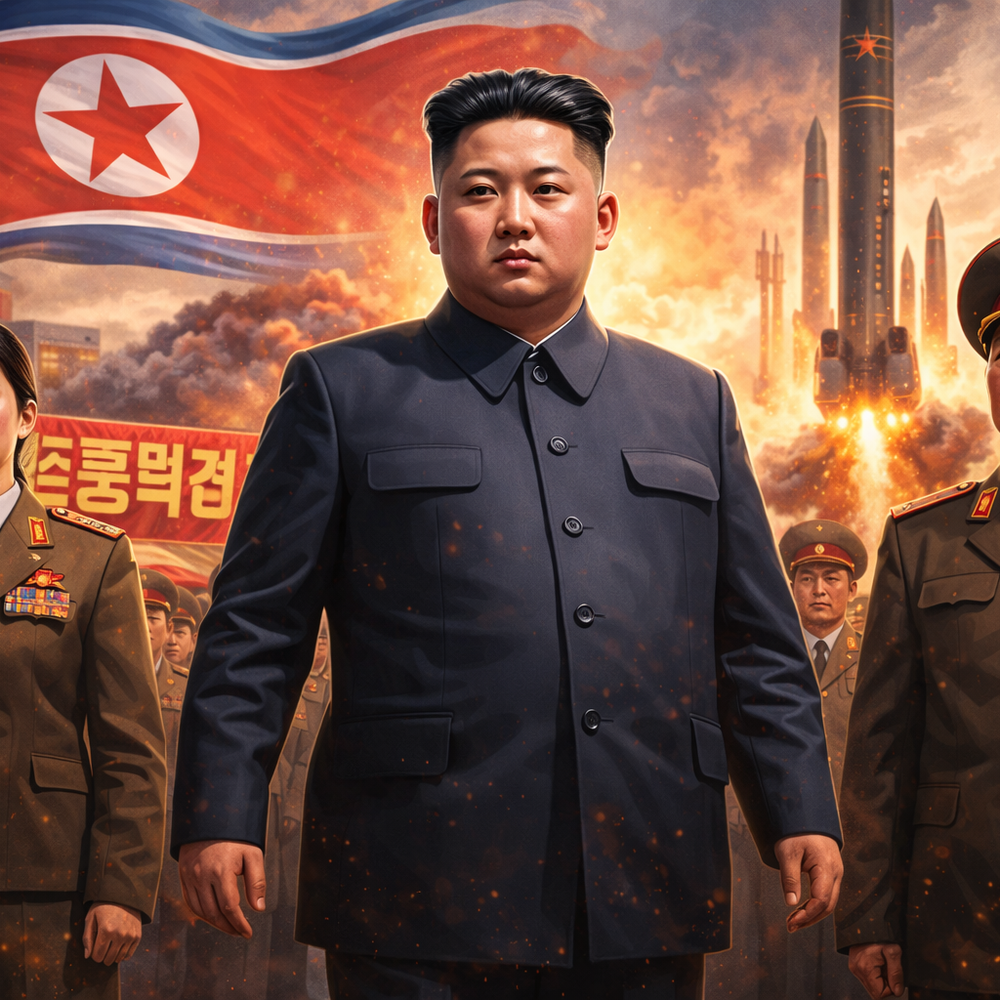
Kim Jong-un (reportedly born January 8, 1984) became the third Supreme Leader of North Korea in 2011 following the death of his father, Kim Jong-il, the country’s second leader.
He also serves as the Supreme Commander of the Korean People’s Army and the head of the ruling Workers’ Party of Korea (WPK).
Although certain economic and social changes have been implemented during his rule, his leadership has faced international criticism due to alleged human rights violations and the harsh suppression of political opposition. At the same time, under his leadership, North Korea’s nuclear and ballistic missile programs have been significantly expanded.
Early Life and Education
Information regarding Kim Jong-un’s early life is limited and largely based on statements from state-controlled media.
According to available reports, he was born on January 8, 1984, in North Korea. His father was Kim Jong-il, and his grandfather was Kim Il-sung, the founding leader of the country.
He is reported to have two siblings:
-
Kim Jong-chol (older brother)
-
Kim Yo-jong (younger sister), who currently holds a senior position within the country’s leadership
It is believed that he spent part of his childhood in Switzerland. He later continued his education in Pyongyang at Kim Il-sung University and Kim Il-sung Military University, where he reportedly studied physics and received military training.
Rise to Power
For many years, it was widely assumed that Kim Jong-il’s eldest son, Kim Jong-nam, would succeed him. However, it was later announced that Kim Jong-un had been chosen as the successor.
Beginning in 2009, he started appearing publicly as the designated heir. In 2010, he was promoted to the rank of four-star general and elevated to a senior position within the party leadership.
Following Kim Jong-il’s death on December 17, 2011, Kim Jong-un was officially declared the Supreme Leader of North Korea. At the time, he was under 30 years old and assumed command of one of the world’s largest standing armies.
Domestic Policy and Economic Approach
After assuming power, Kim Jong-un declared the parallel development of the economy and military strength as a national priority.
Under the so-called “May 30 Measures,” certain enterprises were granted limited operational autonomy. These reforms are reported to have contributed to increased agricultural production and a broader availability of consumer goods in the domestic market.
Pyongyang has also seen the construction of new residential complexes, entertainment facilities, recreational centers, and infrastructure projects.
Nuclear and Defense Policy
During Kim Jong-un’s leadership, North Korea significantly accelerated its nuclear weapons and missile development programs. Several underground nuclear tests and long-range missile launches triggered strong reactions from the international community.
In 2017, the United States designated North Korea as a state sponsor of terrorism. According to various intelligence reports, the country’s nuclear arsenal expanded during this period.
Leadership Style
Kim Jong-un’s leadership style is characterized by centralized authority and strict control mechanisms. Reports indicate that after taking power, several high-ranking officials were removed from office or punished.
The 2013 execution of his uncle, Jang Song-thaek, attracted significant international attention.
The United Nations and other international organizations have published critical reports regarding the human rights situation in North Korea.
Personal Life
Kim Jong-un married Ri Sol-ju in 2009. It is reported that the couple has at least one child.
Although information about his private life is limited, he is known for his interest in luxury vehicles and sports, particularly basketball. In 2013, he met American basketball player Dennis Rodman, an event that drew global media attention.
Conclusion
Kim Jong-un is considered one of the most controversial political figures of the 21st century. During his leadership, North Korea has remained in the global spotlight due to both economic developments and military expansion.
Despite ongoing international sanctions and criticism, he has consolidated his authority domestically and maintained firm political control.