
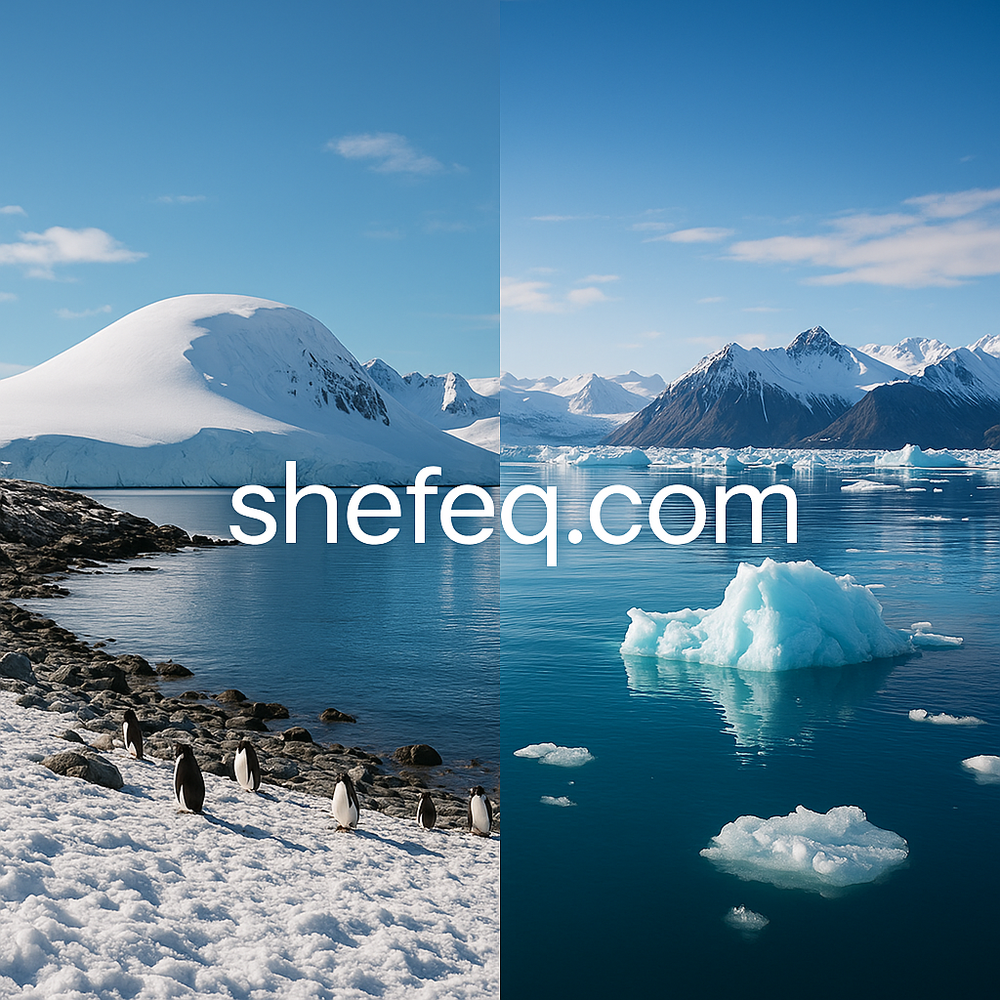
At the two ends of our planet lie two opposite poles:
Antarctica in the South and the Arctic in the North.
These icy regions are both similar and very different.
Let’s explore their mysteries and fascinating facts together!
Antarctica – The Ice Kingdom of the South
Antarctica is the southernmost continent on Earth, home to the South Pole itself.
It is surrounded by the Southern Ocean, and most of its surface is covered by a thick sheet of ice.
Interesting Facts about Antarctica:
• Antarctica is larger than Europe and nearly twice the size of Australia.
• Most of the continent is covered by ice about 1.6 kilometers (1 mile) thick.
• Because it receives very little precipitation, Antarctica is technically classified as a desert.
• The coldest temperature ever recorded on Earth occurred here: −89.2°C (−128.6°F) at Vostok Station in 1983.
• There are no permanent residents, but several thousand scientists and researchers live and work year-round at research stations.
• Despite its harsh conditions, some plants and animals have adapted to survive there.
• The most famous inhabitants are penguins and seals.
• The word “Antarctica” comes from Greek and means “opposite to the north.”
• About 90% of the world’s ice reserves are found in Antarctica.
• If all Antarctic ice were to melt, global sea levels would rise by about 60 meters (200 feet).
The Arctic – The Frozen World of the North
The Arctic lies at the northernmost part of the Earth, surrounding the North Pole.
It includes both the Arctic Ocean and parts of the countries that border it.
Interesting Facts about the Arctic:
• The Arctic region includes parts of Russia, Greenland, Canada, the USA (Alaska), Norway, Iceland, Sweden, and Finland.
• The name “Arctic” is of Greek origin and means “near the bear,” referring to the constellation Ursa Major (the Great Bear).
• The lowest recorded temperature in the Arctic is −68°C (−90°F).
• Indigenous peoples — such as the Inuit, Saami, and others — have adapted their lifestyles perfectly to the cold climate.
• The Arctic is home to polar bears, wolves, squirrels, walruses, seals, and many bird species.
• During short warm seasons, mosses, lichens, grasses, and small shrubs can grow.
• The region is rich in natural resources such as fish, oil, gas, and minerals.
• In recent decades, global warming has caused Arctic ice to melt at an alarming rate.
Comparison of the Two Poles
| Feature | Antarctica | Arctic |
|---|---|---|
| Location | South Pole | North Pole |
| Type | Continent (landmass) | Ocean with surrounding lands |
| Population | No permanent residents | Indigenous peoples live there |
| Animals | Penguins, seals | Polar bears, walruses, foxes |
| Climate | Colder and drier | Relatively milder |
| Ice Coverage | Contains 90% of Earth’s ice | Ice-covered seas |
Conclusion
Antarctica and the Arctic are the most extreme yet most magnificent regions of our planet.
They are not only realms of ice and cold — they are miracles of science, life, and nature.
To protect these two poles means, in truth, to protect our entire planet.