
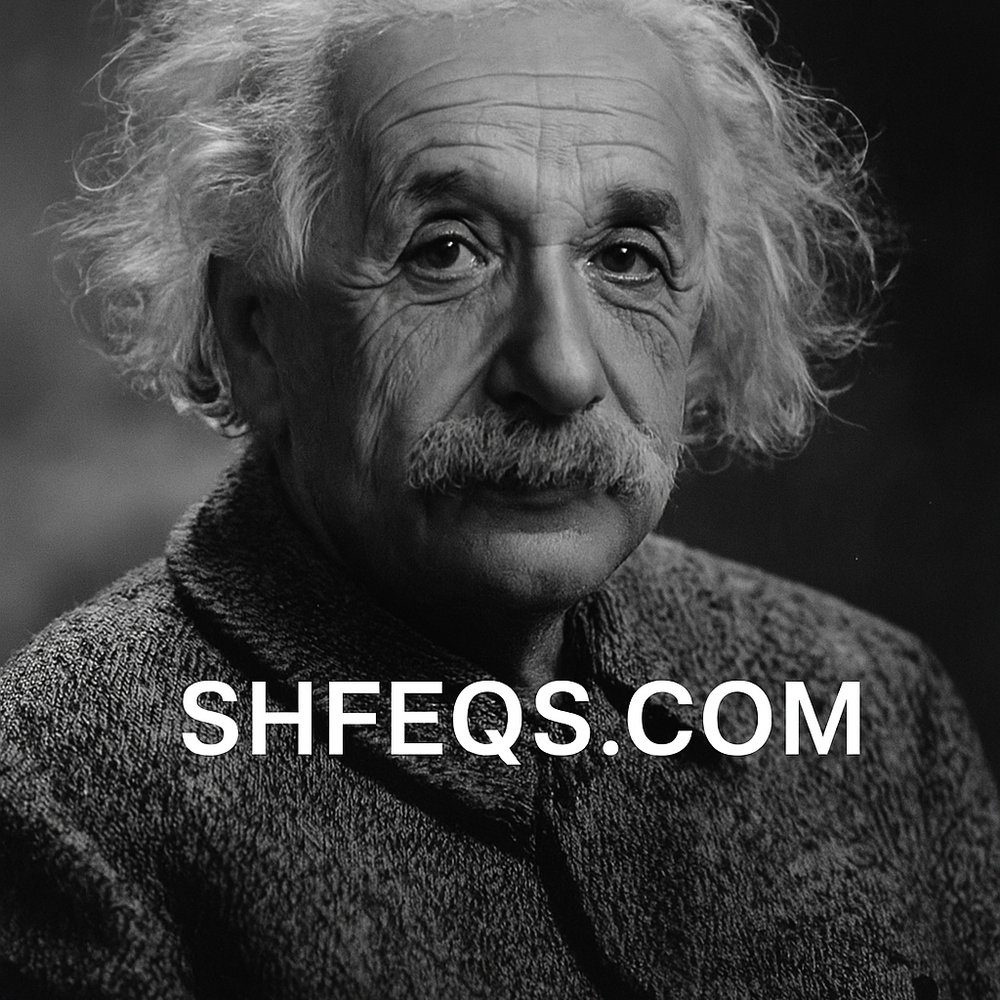
Introduction – From a Silent Childhood to the Mind of Humanity
Sometimes a person can transform not only their own era but future centuries as well. Albert Einstein—once a late-talking child, labeled “lazy” by teachers—became a symbol of science in human history. He was not just a physicist; he was also a philosopher, a defender of human rights, a pacifist, a music lover, and a voice of conscience. His life shows that a scientist can transcend the laboratory and become a profound influence on society and humanity. Through his science, he reshaped our concept of time, and through his ideas, he reinvigorated human values.
I. What Kind of Child Genius Was He? – Albert’s Origins and First Steps
Albert Einstein was born on March 14, 1879, in Ulm, Germany, into a middle-class Jewish family. His father, Hermann, was an engineer, and his mother, Pauline, had a passion for music and culture. This created a dual influence: fostering both his mathematical mind and emotional sensitivity. As a child, he talked late and avoided typical play—some later speculated about an autistic spectrum. Yet his deep, contemplative mind shone through, sparked by playing with a magnetic compass and wondering how the universe worked
II. An Unconventional Education
Einstein struggled in traditional schooling, bored by rote learning and vulgar authority. He loved math and physics, which ignited his imagination. In 1896, he enrolled at the Swiss Federal Polytechnic in Zurich, where he met Mileva Marić, who shared his passion for science . Unable to secure an academic position after graduation, he found work at the Swiss Patent Office in Bern—a “mundane” job that, ironically, gave him the freedom to conduct his revolutionary research
III. 1905 – The Miracle Year of Science
In 1905, Einstein published four groundbreaking papers that forever changed physics:
-
Photoelectric effect – foundational to quantum theory and Nobel Prize–winning in 1921
-
Brownian motion – provided evidence for atomic theory.
-
Special relativity – introduced a new understanding of time and space.
-
E = mc² – showed mass–energy equivalence, paving the way for atomic energy.
These works marked an extraordinary year in science .
IV. A New Era – The Theory of General Relativity
In 1915, Einstein published his general theory of relativity, describing gravity as the curvature of space-time. Though initially met with skepticism, observations during the 1919 eclipse confirmed his predictions and made him globally famous .
V. Human Rights and Political Stances
Einstein consistently spoke up for justice:
-
He opposed Nazism and supported refugees.
-
In the U.S., he denounced racial segregation.
-
Though initially a proponent of atomic research, he later advocated for nuclear disarmament.
-
He supported Israel’s creation but declined its presidency in 1952, seeing politics as incompatible with scientific thinking .
VI. Science and Ethics – A Mindful Approach
Einstein believed science must serve humanity and conscience, saying, “Science without conscience is dangerous.” He rejected dogmatism and described himself as experiencing a “cosmic religious feeling.” His famous critique of quantum mechanics—“God does not play dice”—revealed his discomfort with randomness in science .
VII. Personal Life and Inner Conflicts
Einstein’s personal life was turbulent. He had two sons with his first wife, Mileva: Hans Albert and Eduard, the latter suffering from schizophrenia—a source of great personal pain. After a divorce, he married his cousin Elsa
VIII. Legacy and Immortality
Einstein died in April 1955; his brain was removed for study—a controversial act. Today, his name graces universities, scientific laws, an asteroid, and even the element einsteinium (atomic number 99). His iconic portraits and quotations have made his image synonymous with genius .
Conclusion – An Unchanging Spirit in a Changing World
Einstein's life proves that profound ideas often originate from simple thoughts. He was the convergence of intellect, imagination, and moral conscience. To anyone pursuing science, his journey remains a beacon. As he famously said: “Never stop learning. Stay curious.”